 +1 236 818-4554
People come to a Palm Reading in Vancouver for all sorts of reasons. Some want to understand themselves better. Others have questions about where their career is headed, what their relationships say about them, or whether a big change is on the horizon. These are the kinds of questions that sit quietly in the back of your mind — and palmistry has long been one way people try to explore them. Pandit Nataraju works with people from all walks of life, offering palmistry alongside Vedic astrology and spiritual guidance. A palm reading, as practised here, is a traditional interpretive art. It invites reflection. It does not claim to be a science, and it does not promise to hand you a fixed version of your future.


Your Palm Is More Than Just a Set of Lines
Most people glance at their palm and see a handful of creases. But palmistry treats those creases — and much more — as a kind of personal map. The heart line has traditionally been read in connection with emotion and affection. The head line speaks to how a person thinks and makes decisions. The life line is often linked with vitality and general outlook. The fate line tends to be read in terms of direction and purpose.
Lines, though, are only the beginning. The shape of the hand, finger lengths, the raised pads known as mounts, and smaller markings all play a part. Contemporary palm readers tend to look at the hand as a complete picture rather than fixating on one line in isolation. Finger proportions, hand shape, and finer details are given real weight too. No two hands are alike, which is what makes each reading its own conversation.
What People Want to Know From a Palm Reading
People rarely walk in with a vague sense of curiosity. Most come with something specific on their minds. A reading naturally follows those questions rather than running through a standard checklist.
- Relationships: emotional tendencies, attachment styles, and the patterns that show up in how you connect with others.
- Career: where your strengths lie, which professional directions suit you, and when shifts may occur.
- Finances: traditional interpretations tied to financial habits, caution, or periods of stability.
- Travel and relocation: markings historically associated with movement, change of place, or new beginnings abroad.
- Life direction: personality, the way you make decisions, and the transitions that leave a lasting mark.
Love, marriage, work prospects, financial steadiness, foreign travel — these come up in nearly every consultation. They are brought to the table with genuine care, and they are treated that way.
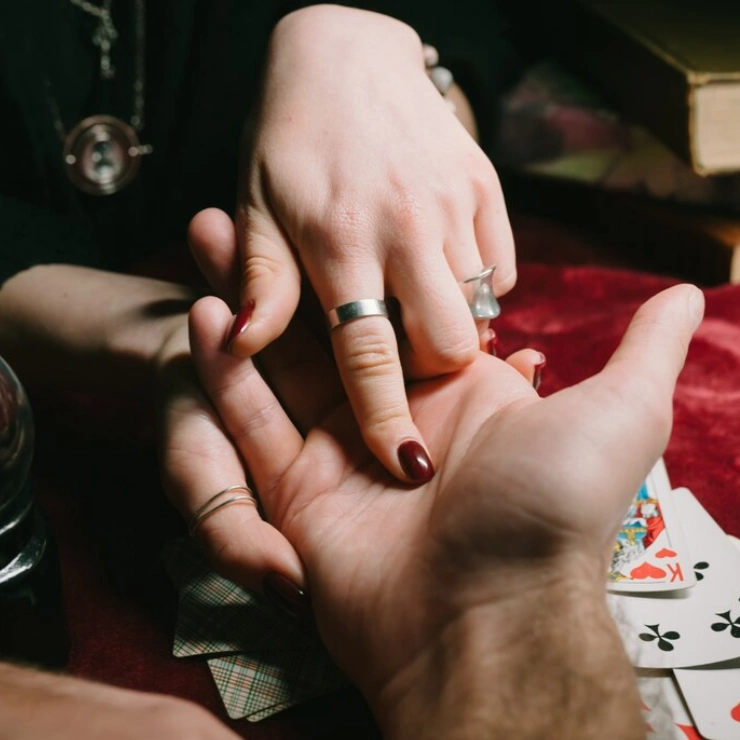
Why Both Hands Can Matter in a Palm Reading
One thing that surprises many first-time visitors is that palmists often want to see both hands, not just one. People regularly ask which hand matters more, whether their writing hand carries extra significance, and why their two palms might look so different from each other.
The answer depends on the tradition being followed. Some palmists hold that the dominant hand shows how traits have developed through experience, while the non-dominant hand reflects what a person was born with. Others approach it differently. Either way, comparing both hands tends to produce a fuller picture, which is why many practitioners — and the wider palmistry community — ask to see both palms clearly before drawing any conclusions.
Palm Reading in Vancouver Can Offer Different Perspectives
These are two distinct practices, and it helps to understand what sets them apart. Palmistry works from what is physically present — the lines, shapes, and markings of your hands. Vedic astrology works from your birth data, constructing a chart based on the date, time, and place of your birth. Someone might choose palmistry precisely because they want a reading grounded in something they can hold up and look at, with no birth certificate required. Someone else may prefer the depth of a chart-based consultation. Both are traditional systems with their own logic and their own history. One does not validate or disprove the other. You simply choose the approach that fits what you are looking for.
Preparing for a Palm Reading in Vancouver
A little thought beforehand makes a real difference. If you are planning a Palm Reading in Vancouver with Pandit Nataraju, a few straightforward things will help.
- Wash your hands and make sure your palms are clearly visible.
- If you are sharing photos, take them in good natural light.
- Include both hands where possible.
- Know which hand you write with — your dominant hand.
- Write down the questions that actually matter to you before you arrive.
This is especially useful when the questions involve marriage, children, or longer-term patterns in life. And one thing worth keeping in mind: no single line is going to hand you a neat answer to everything. A good reading draws on many features together and gives you something honest to consider
Explore Your Palm Reading With Pandit Nataraju in Vancouver
If you live in Vancouver and have been curious about what a traditional palm reading might reveal, the option is there. Pandit Nataraju sees people with questions about relationships, career, personal direction, and the kinds of changes that feel hard to navigate alone. A Palm Reading in Vancouver with him is a calm, honest conversation — not a performance, not a set of predictions delivered at speed.
Sessions can take place in person or, where it works better for you, through remote consultation. Either way, the reading itself stays the same.
FAQs
No. Traditional palmistry works from your hands, so your date and time of birth are not usually required. That is one of the clearest differences between palmistry and Vedic astrology, which builds everything from your birth chart.
Most palmistry traditions treat both hands as significant. Looking at them together gives a more complete picture than either hand alone, which is why practitioners and online palmistry communities alike tend to ask for clear images of both palms.
It depends on the tradition. Many palmists make a distinction — reading the dominant hand for traits that have developed through lived experience, and the non-dominant hand for inherited tendencies or unrealised potential. Ask your practitioner how they approach it, since the method varies.
Marriage lines and related markings are read as symbols, not schedules. They can point to themes around love and commitment and prompt useful reflection. They are not a verified method for naming a specific date, and any reading that claims otherwise should be approached carefully.
Skin changes with age, physical condition, and time — and the lines on your palm can shift along with it. Some palmistry traditions attach meaning to these changes, while others are more cautious about reading too much into them. The palmistry community itself is divided on this point, so it is worth treating any change as something to reflect on rather than a firm signal about what is coming.